

At 2:17 a.m. in a tiny one-room office in Pune, the lights were still on.
Three laptops. Four coffee cups. One whiteboard full of messy ideas.
And a problem that didn’t just belong to India — it belonged to the world.
Aarav rubbed his eyes and said,
“Guys… what if clean water didn’t need electricity at all?”
Meera looked up. “You mean… for villages?”
Aarav shook his head.
“For everywhere.”
A Problem Bigger Than Borders
The startup was called JalSetu. No investors. No fancy office. Just three engineering friends who were tired of reading the same news:
-
Millions without clean drinking water
-
Children sick from contamination
-
Climate disasters worsening water scarcity
At first, they wanted to help rural Maharashtra. That felt big enough.
But the more they researched, the more they realized something shocking:
The same water crisis existed in Africa, Southeast Asia, and even parts of developed countries during disasters.
“This isn’t a local problem,” Meera whispered one night.
“It’s a global one wearing different clothes.”
A Small Idea With Massive Impact
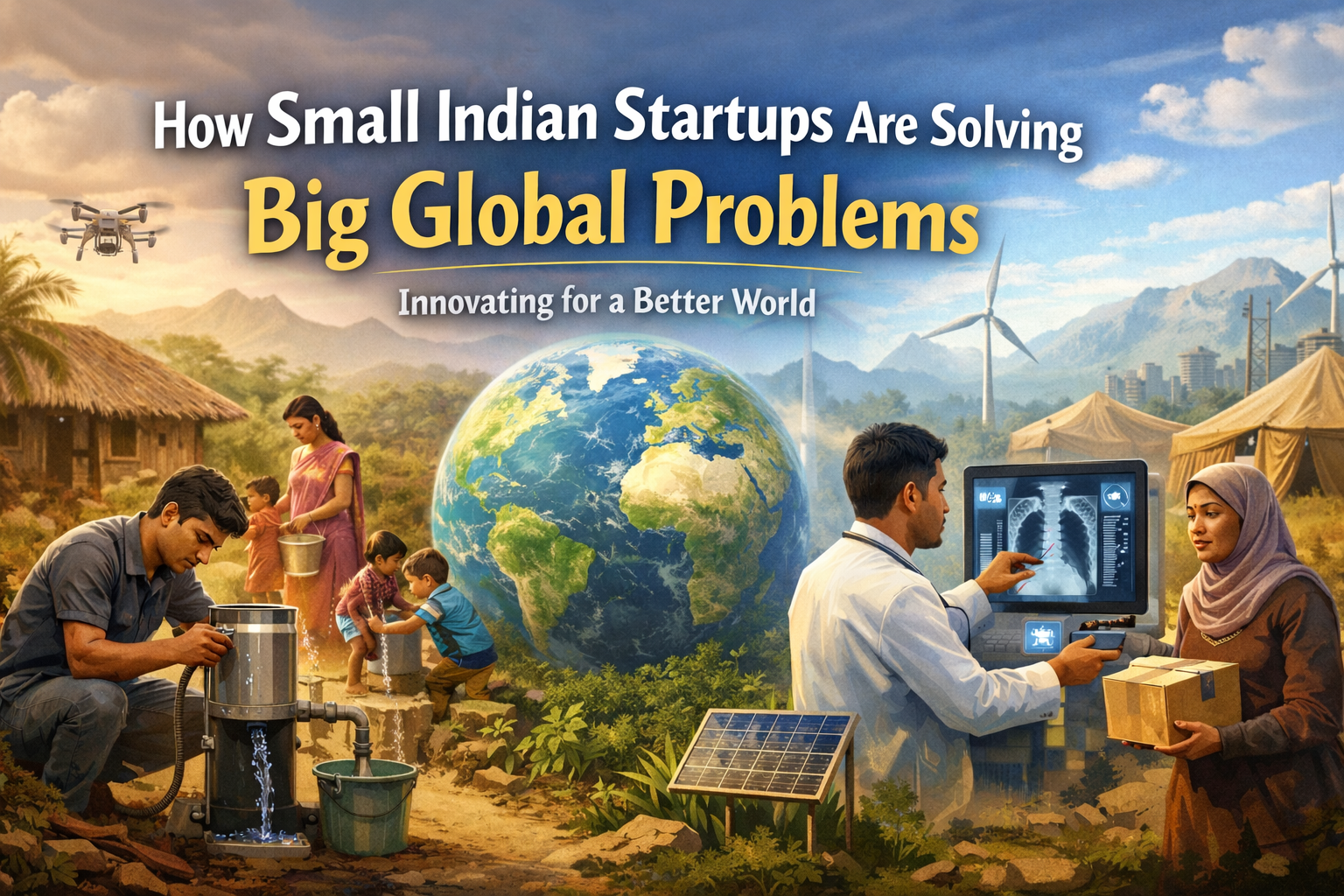
They built a low-cost, gravity-based water filter using locally available materials — no electricity, no chemicals, no expensive parts.
The first prototype looked ugly.
The second one leaked.
The third one worked.
When they installed it in a small village school, the principal called them after two weeks.
“Attendance is up. Kids aren’t falling sick.”
Aarav expected relief.
Instead, he felt something else.
Responsibility.
From Village to the World
One day, a volunteer posted about JalSetu online. The post went viral.
Soon, emails came from:
-
A relief organization in Kenya
-
A flood-hit region in the Philippines
-
A refugee camp in Jordan
Meera stared at the inbox.
“We’re just a 3-person startup… how are we supposed to handle this?”
Aarav smiled nervously.
“Maybe we stop thinking small.”
They partnered with local NGOs, shared open-source designs, and trained communities to build the filters themselves.
They didn’t just sell a product.
They shared a solution.
The New Face of Indian Innovation
JalSetu wasn’t alone.
Across India, small startups were doing the same:
-
A Bangalore company creating AI tools for affordable healthcare diagnostics used in African clinics
-
A Jaipur startup turning agricultural waste into eco-packaging shipped to Europe
-
A Chennai team building solar cold storage helping farmers from India to Indonesia
They weren’t trying to be “global brands.”
They were just trying to solve real problems.
But real problems don’t respect borders.
Purpose Over Hype
One evening, after a long day, Meera asked,
“Do you ever wish we built something flashy instead? An app or something?”
Aarav laughed.
“We did build an app.”
She looked confused.
He pointed to a map on the wall, dotted with pins across continents.
“This is our app. It just runs on people, not phones.”
The Bigger Truth
These startups don’t have billion-dollar funding.
They don’t trend on social media every day.
They don’t have glass buildings or global PR teams.
But they have something stronger:
Problems worth solving.
And that’s why small Indian startups are quietly doing something extraordinary —
They’re proving that you don’t need to be big to make a global impact.
You just need to care enough to start.